
The Untold Truth About Arranged Marriages: Love, Compromise, and Collateral Damage
Arranged marriages have been celebrated in India for centuries—but what lies behind the grand weddings and family decisions? This blog uncovers the harsh truths, the silent struggles, and the generational trauma hidden beneath the tradition. If you believe divorce is a stigma, think again—sometimes, walking away is the bravest thing you can do. .......Click here to read full blog! Just takes couple of minutes to read!
8/17/20254 min read
Arranged Marriage in India: A Reality Check
Arranged marriage—Indians are extremely fond of it. This practice has been deeply rooted in our culture for centuries. I know people in the age group of 40 to 70 might get offended while reading this, but I want to share the reality of what often happens behind the scenes in arranged marriages.
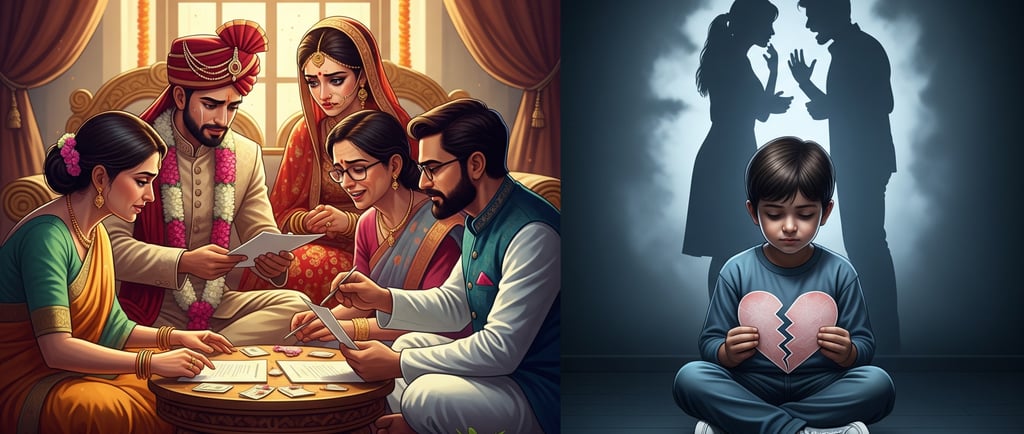
In my opinion, an arranged marriage is nothing less than a business deal. Two families sit together and discuss money, property, and social status—not the likes, dislikes, or compatibility of the boy and the girl. Now, I am not saying love marriages are 100% successful either. Every relationship has its challenges. But in love marriages, at least the two individuals mutually decide to tie the knot and lead a life together. In arranged marriages, the decision is largely made by the families, and the couple is expected to agree.
(And no, I’m not talking about teenage love marriages—those are a different story, and I’ll write about that another time!)
From what I’ve seen, happy arranged marriages are rare. Maybe 10 out of 100 couples truly live happily, while the remaining 90 are struggling. And these unhappy marriages don’t just affect the couple—they shape the future of their children in ways most people don’t realize. Let me share a real-life story.
A True Story That Reflects the Flaws
A couple got married in 1992 through an arranged marriage. The boy didn’t like the girl because she was dark-skinned and didn’t match his idea of beauty. The girl, on the other hand, agreed to marry him because she liked his looks—he was handsome and charming.
But there was another reason the marriage happened—the boy’s financial condition was very poor, and he agreed because the girl’s family was financially stable. From the beginning, there was no emotional connection, no understanding—just compromises and forced adjustments.
Soon after marriage, his parents pressured them to have a child. So, without love or emotional bonding, they brought a child into the world. And that’s when the real cracks appeared. Their fights became frequent. Instead of thinking about the child, they drowned in arguments, blame games, and resentment.
The mother wanted to divorce him, but in Indian households, divorce is seen as a suicide bomb. So, she stayed—choosing compromise over freedom.
The child grew up in this toxic environment. Her parents gave her everything—education, money, gold—but never gave her love. They didn’t know what parenting truly meant. They thought providing material things was enough, but what the child needed most was affection, validation, and emotional support.
As she grew older, she craved love from outsiders—classmates, friends, anyone who showed her a little care. She tried to be sweet and pleasing to everyone just to get attention. But people took advantage of that vulnerability. Even when she was bullied, she stayed quiet because love mattered more to her than self-respect.
She fell in love multiple times, only to be emotionally shattered each time. Every wrong relationship drained her further.
And there’s another big flaw in Indian parenting—comparison. Whenever she brought her report card, instead of appreciating her good marks, her parents compared her with someone who scored 5 or 10 marks higher. Even when she did her best, they never said, “We’re proud of you.”
This constant lack of validation crushed her confidence. She always tried to prove herself worthy, but deep down, she felt she would never be enough. She was capable of cracking the toughest exams—even the IAS—but her subconscious mind whispered: “Even if I give my best, it won’t be enough for my parents. Why try?”
Even when a child grows mature enough to talk about healthy parenting, many parents refuse to listen. They shut the child down with harsh words like:
“Don’t tell us what to do. You are here to obey us, that’s it.”
This mindset creates a wall, a wall where love, respect, and open communication simply cannot exist.
And this doesn’t stop here. I have seen several arranged marriages where the couple gets married without truly liking each other, only to later seek love and companionship outside the marriage. I am not here to judge them, it’s their life, their choices. But here’s the truth: this entire cycle of pain could have been avoided if someone had the courage to say one simple word at the beginning—“NO.”
Why Saying NO Matters
One “NO” at the right time can prevent a lifetime of unhappiness, not just for the couple, but for the children who are often the silent victims of these forced relationships.
And to those who look at divorce as a taboo, let me say this loud and clear:
Divorce is far better than living a loveless, toxic marriage and damaging a child’s future.
Sadly, many of us silently agree with this thought but never say it out loud. Instead, we look at divorced individuals with judgmental eyes, as if they have committed a crime. This perspective must change.
Breaking the Cycle of Generational Trauma
The 1990s generation understood the meaning of collateral damage and generational trauma caused by forced marriages. And that is why most millennials today prefer choosing their own partners—because they don’t want to pass this cycle of pain, compromise, and emotional neglect to the next generation.
Love, respect, and understanding are not luxuries in a marriage—they are necessities. And if those don’t exist, the cost is too high, not just for the couple but for the family that follows